Read the full story at La Converse.
When Dr. Kevin Brousseau isn’t working as the only on-duty physician at the Healing Centre in Oujé-Bougoumou, a municipality in the Eeyou Istchee territory of central Quebec, he puts his linguistics degrees to good use by editing the world’s largest Cree dictionary.
“Before even getting these degrees, I had actually been compiling lists of words in my own dialect since I was a teenager,” says Brousseau, whose family hails from the neighbouring Eeyou Istchee municipality of Waswanipi. “I guess it was always a plan to work on dictionaries.”
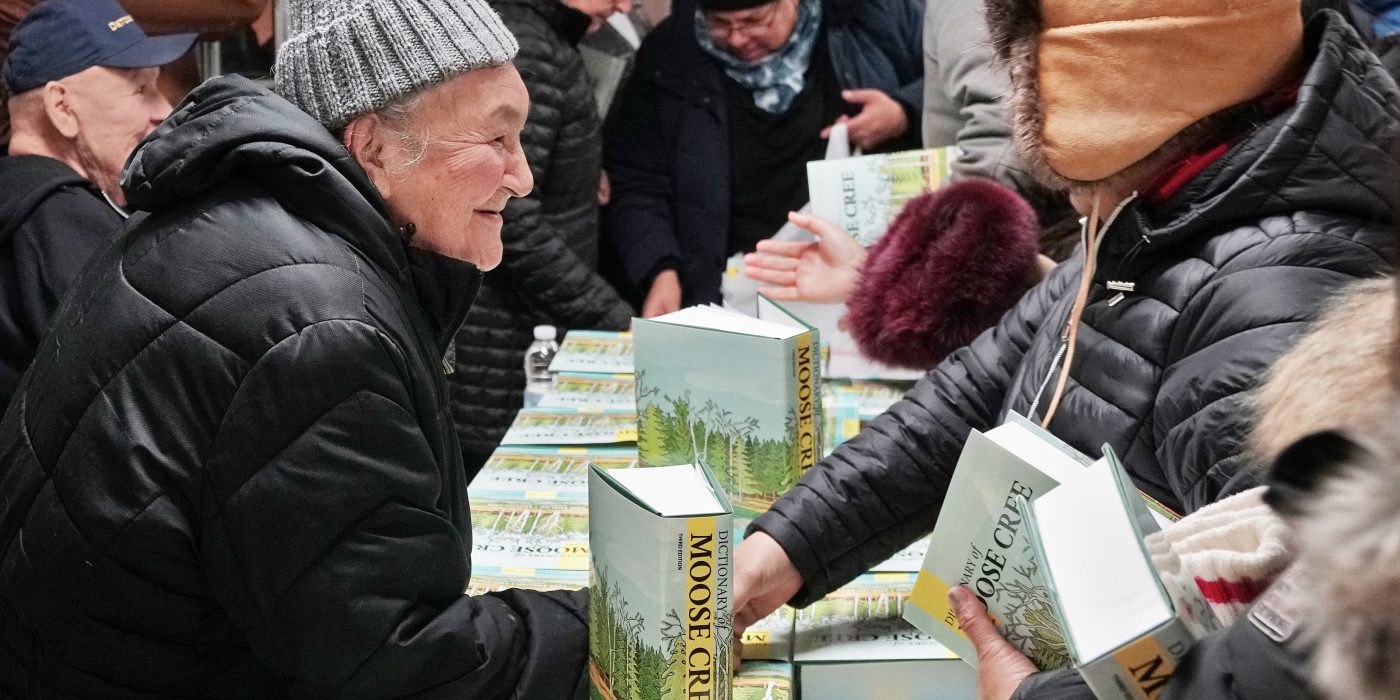
He switched to medicine in his 30s to serve Cree patients in their mother tongue but continued working as editor of the Moose Cree dictionary, which was updated to its fourth edition in November 2025. The new release includes more than 34,000 Cree terms translated to English and around 5,500 English to Cree entries that Brousseau has collected for the project since 2012.
Beyond splitting his attention between these two jobs and publishing academic works on old Cree with the Canadian Museum of History, Brousseau is facing many obstacles in his mission to help Cree people learn their language. Low numbers of fluent Cree speakers, a lack of modern texts that help people practice the language, and underfunding for Indigenous cultural projects have required Brousseau and Moose Cree First Nation to find clever solutions while paying for the project themselves.
And Brousseau says they’re far from the only Indigenous community facing these challenges in Canada.
Photo caption: Hilda Jeffries (left) is one of the dictionary’s contributors. She spends hours talking on the phone with editor Brousseau to provide new words for the project. Photo courtesy of Geraldine Govender at Moose Cree First Nation